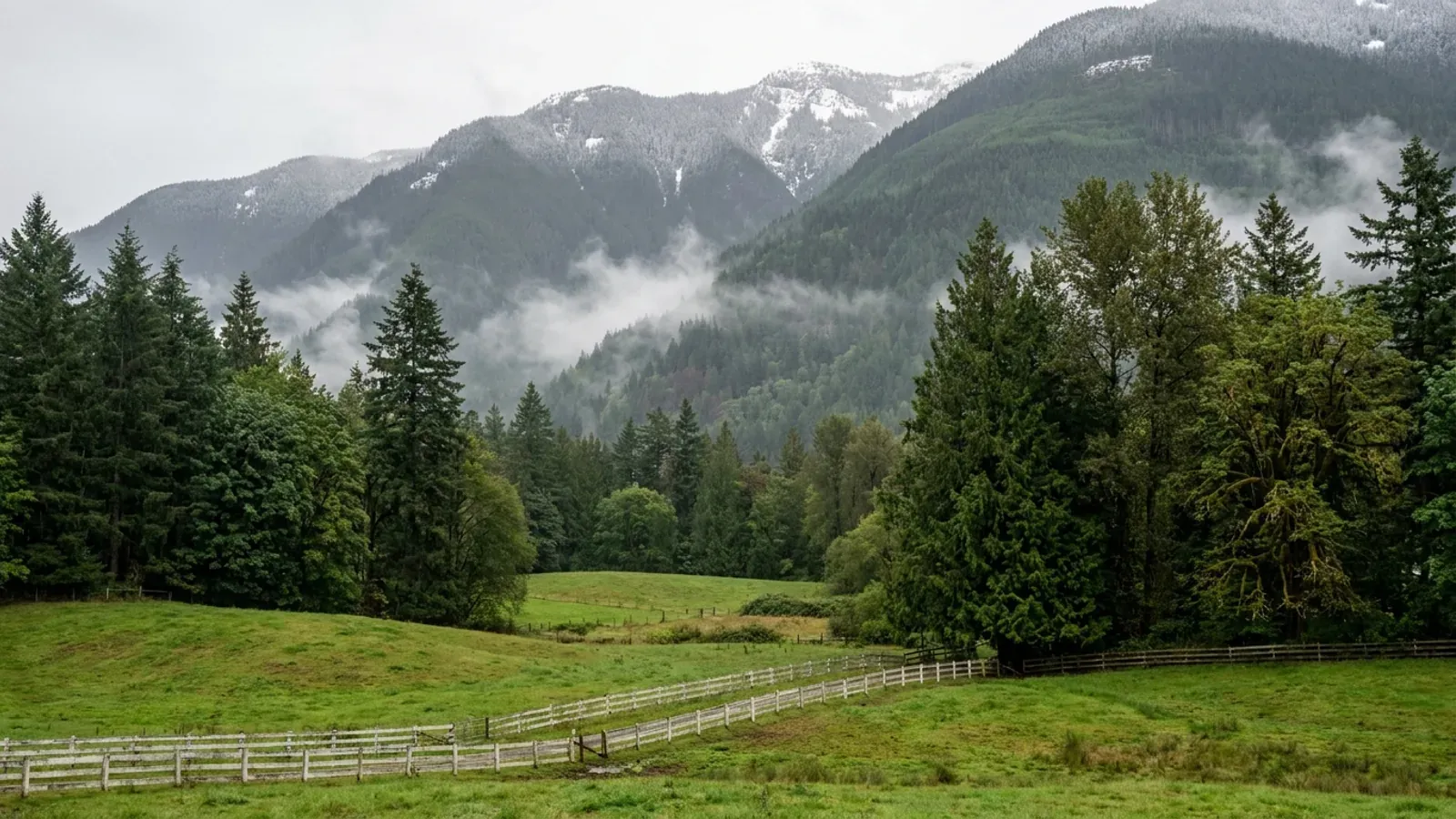
Barndominium Builders in Vancouver, British Columbia
Vancouver is a fully urban city of serviced lots, with no acreage market inside its limits, so it helps to be clear about what a barndominium means here. On a Vancouver lot it is a modern house with steel or post-frame styling, a tall open main floor and perhaps a workshop, designed to the lot's zoning district and permitted by the City. The City of Vancouver also writes its own building by-law rather than following the provincial code the rest of British Columbia uses, so a plan drawn for a lot elsewhere in the province still has to be checked against the Vancouver rules. Most people who want the full barn-style home with a big shop bay and room around it look east instead, to the farm and rural land of the Township of Langley and the Fraser Valley Regional District. We build both kinds of project: steel-frame barndominiums and post-frame homes on rural parcels, and custom plans shaped around a city lot's limits. Tell us about the property through the survey and we will look at the zoning, servicing and permits before any drawing starts.
Vancouver at a glance
- Municipality
- City, Metro Vancouver Regional District
- Population
- 662,248 (2021 Census); 740,454 (July 2025 estimate)
- Building permit
- City building office
- Land and acreage
- Serviced city land; acreage in Township of Langley and Fraser Valley Regional District
- Wastewater
- Municipal sewer
- Water
- Municipal water
Barndominium Builders Near Vancouver
From a turnkey build to a shell you finish yourself, the work starts with the parcel: the access, the building pad, the route to a sewer or a private sewage system, and the water source. The parcel decides the budget more than the floor area does, so each option is priced against your land rather than a rate card.
Turnkey Builds
Turnkey barndominiums in Alberta, Saskatchewan and BC: one team from bare land and permits to a finished, inspected house, water and septic planned in.
Custom Plans
Custom barndominium plans for Alberta, Saskatchewan and BC: floor plans and permit drawings drawn for your parcel, your loads and your municipality.
Site Preparation
Barndominium site preparation in Alberta, Saskatchewan and BC: clearing, grading, drainage, access and the building pad, planned around well and septic.
Permitting
Barndominium permits in Alberta, Saskatchewan and BC: development and building permits, trade permits, septic, and who issues each one.
Post-Frame and Steel-Frame Barndominiums Near Vancouver
A post-frame home, often called a pole barn home, sets its frame on widely spaced posts and suits a wide, simple layout with a shop bay under the same roof. A steel-frame barndominium uses a bolted steel frame, and an RTM (ready-to-move) home is built off site and moved to the land. Which one fits comes down to the land use rules, the site and the design values for your location.
Post-Frame Homes
Post-frame and pole barn homes in Alberta, Saskatchewan and BC: a wide-open shop and a house on one column-and-truss frame, built as a real home.
Steel Construction
Steel-frame barndominiums and metal building homes in Alberta, Saskatchewan and BC: clear-span frames for a shop and a house, finished for winter.
RTM Homes
RTM homes in Alberta and Saskatchewan: ready-to-move barndominiums built in our yard, moved to your land and set on the foundation built there.
Shouses
Shop houses (shouses) in Alberta, Saskatchewan and BC: a working shop and a home under one roof, planned around the land use bylaw, water and septic.
Building a Barndominium in Vancouver: Permits, Land Use, Sewage and Water
On acreage the land use, sewage and water answers often come before the building answer. Here is who decides each part in Vancouver, taken from the office or document that publishes it. Rules change, so check them again against your parcel before anything is drawn.
City of Vancouver Development and Building Services Centre
A new single detached house in Vancouver goes through a combined development and building permit, applied for on the City's Development and Business Services website. A sewer and water connection permit has to be applied for first. Plumbing, electrical, gas and sprinkler work take separate trade permits, and work must begin within six months of issue or the permit lapses.
Source: Build a new duplex, single detached house, or laneway house, City of Vancouver (vancouver.ca)
City of Vancouver Zoning and Development By-law 3575
The Vancouver Charter gives the City its power over land use, and the Zoning and Development By-law sets which uses are allowed, where a building may sit on its site and how tall and large it may be. Each property falls in a zoning district whose schedule holds those rules. Rural acreage is found outside the city, chiefly in the Township of Langley and the Fraser Valley Regional District.
Source: Zoning and Development By-law 3575, City of Vancouver (vancouver.ca)
City of Vancouver water and sewer system
Every Vancouver lot is on the City's sewer network, which carries sewage and excess water away for treatment, while rainwater and runoff are collected separately for release to local waterways such as Burrard Inlet and the Fraser River. A rural parcel beyond the sewers needs an onsite system designed by an authorized person and filed with the regional health authority.
Source: How the water and sewer system works, City of Vancouver (vancouver.ca)
City of Vancouver waterworks (supply purchased from Metro Vancouver)
Vancouver buys its drinking water from Metro Vancouver. It starts as rain and snowmelt in the Capilano, Seymour and Coquitlam watersheds, which are closed to the public, and is treated at the Seymour-Capilano Filtration Plant and the Coquitlam Water Treatment Plant before it reaches the city. Acreage off a municipal system usually depends on a drilled well.
Source: Your drinking water, City of Vancouver (vancouver.ca)
- Vancouver's own building by-law
- City Council adopted the Building By-law 2025 (VBBL 2025) on May 20, 2025, and it generally took effect on September 15, 2025. Its seismic design provisions did not have to apply to building permits submitted before September 15, 2026.
- Where the region's farmland is
- The provincial Ministry of Agriculture's 2011 land use inventory counted 60,893 ha of Agricultural Land Reserve in Metro Vancouver, 22% of the region's land area. The Township of Langley held the most, 22,281 ha, while the City of Vancouver had 258 ha.
Source: Vancouver Building By-law (CBO), City of Vancouver (vancouver.ca)
Source: Agricultural Land Use Inventory, Metro Vancouver 2011, British Columbia Ministry of Agriculture (www2.gov.bc.ca)
Building on Land Near Vancouver
Vancouver has no acreage market, so a buyer who wants land for a barn-style home and shop is really shopping in another municipality. The provincial agricultural land use inventory puts the largest block of Metro Vancouver's Agricultural Land Reserve in the Township of Langley, and the Fraser Valley Regional District holds more ALR land farther up the valley. On ALR land a parcel is generally limited to one residence, with a principal residence of no more than 500 m², so the size of an attached shop matters from the first sketch. Off the city mains, plan for a drilled well and an onsite sewage system, and read the local zoning bylaw before you make an offer.
Have land in or near Vancouver? Tell us about the parcel and what you want on it, and we will check it against the local rules before anything is drawn.
Building in Vancouver: questions
Start the surveyHow much does a barndominium cost for a Vancouver buyer?
What permits does a new barndominium-style house need in Vancouver?
Where can I find acreage near Vancouver for a barndominium?
Does Vancouver use the same building rules as the rest of British Columbia?
Keep reading
What usually comes next once you know what Vancouver allows.
Barndominium Cost Guide
Sourced price ranges and what moves the number on your land.
Read itCan You Build a Barndominium in Canada?
Permits, licensing, warranty, land use, sewage and water in Alberta, Saskatchewan and BC.
Read itHow Long Does It Take?
From parcel to move-in, and how the winter sets the clock.
Read itSources for this page
The published pages behind the Vancouver facts above. Rules change, so check the current version with the office before you rely on it.
- Build a new duplex, single detached house, or laneway house, City of VancouverBuilding permit authorityvancouver.ca
- Zoning and Development By-law 3575, City of VancouverLand use and nearby rural municipalitiesvancouver.ca
- How the water and sewer system works, City of VancouverSewer or private sewagevancouver.ca
- Your drinking water, City of VancouverWater supplyvancouver.ca
- Vancouver Building By-law (CBO), City of VancouverVancouver's own building by-lawvancouver.ca
- Agricultural Land Use Inventory, Metro Vancouver 2011, British Columbia Ministry of AgricultureWhere the region's farmland iswww2.gov.bc.ca
- Population and dwelling counts: Canada and census subdivisions (municipalities), Statistics Canada table 98-10-0002-01Population, 2021 Censuswww150.statcan.gc.ca
- Population estimates, July 1, by census subdivision, 2021 boundaries, Statistics Canada table 17-10-0155-01Population estimate, July 1, 2025www150.statcan.gc.ca
Other places near Vancouver
Nearby places with their own pages. Across a municipal boundary the permit office, the land use bylaw, the sewage rules and the water source can change, so each is covered separately.
Building in Vancouver?
Start with the survey. Tell us where the land is and what you want on it, and we will come back with which offices decide it, what the land use rules allow, and a plan to fit.